
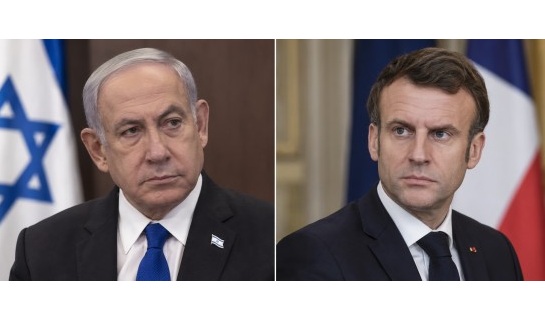
Israeli-French tensions have escalated following a controversial statement by French President Emmanuel Macron at the United Nations General Assembly. Macron’s remarks, perceived as critical of Israeli actions in the West Bank, have drawn a sharp rebuttal from Israeli Prime Minister Benjamin Netanyahu. This diplomatic rift underscores ongoing international disputes over the future of Israeli and Palestinian territories.
Macron’s address at the UN included a statement that Hamas had “never operated in the West Bank,” which was intended to highlight the group’s lack of governance in the area. However, Israeli officials swiftly countered, labeling the statement as inaccurate and pointing to recent attacks in the West Bank attributed to Hamas. The tension intensified after an Israeli-French citizen was killed in the West Bank, with Israel citing the attacker’s Hamas affiliation as evidence of the group’s activity in the region.
In an effort to clarify, a French diplomatic official later stated that Macron’s intention was to convey that Hamas does not govern the West Bank, not to deny its operational presence there. The Palestinian Authority holds limited self-governance in parts of the West Bank, while Israel retains substantial control, adding complexity to the ongoing conflict and international discourse.
Macron’s speech also addressed the humanitarian situation in Gaza and criticized continued violence and settlement activity, arguing these factors hinder the viability of a two-state solution. This perspective mirrors the broader European stance, which often finds itself at odds with Israeli policies regarding the Gaza Strip and West Bank settlements.
These exchanges between Macron and Netanyahu highlight the persistent diplomatic challenges surrounding the Israeli-Palestinian conflict, which continues to evoke strong reactions on the international stage. As global leaders grapple with these complex issues, the path to a peaceful resolution remains fraught with political and territorial disputes.